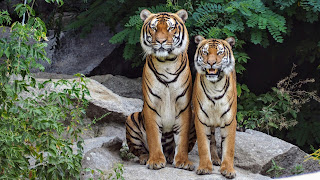

A scientific exploration of
conservation, ecology, and survival
The Bengal Tiger stands as one of the most
powerful symbols of biodiversity and ecological integrity in the natural world.
As the national animal of India, it represents far more than cultural
heritage—it embodies the success and responsibility of modern conservation.
Remarkably, nearly 70 percent of the world’s remaining wild tiger population is
found within India, positioning the country as the global epicenter for tiger
conservation. This concentration underscores not only the ecological richness
of India’s forests but also the effectiveness of sustained conservation
initiatives over the past five decades.

From a scientific perspective,
the Bengal Tiger functions as an apex predator, occupying the highest level in
the food chain and exerting a profound influence on ecosystem dynamics. By
regulating herbivore populations such as deer and wild boar, tigers maintain
vegetation balance and prevent overgrazing, thereby supporting complex
forest structures and
biodiversity. This ecological role extends beyond individual species
interactions and contributes to broader processes such as nutrient cycling and
habitat stability, making the tiger a keystone species in terrestrial
ecosystems.
In the context of global
environmental change, the conservation of the Bengal Tiger has become
increasingly significant. Rapid habitat fragmentation, climate change, and
human population pressures threaten not only tiger survival but also the
integrity of entire ecosystems. As a result, protecting this species is no
longer a regional priority but a global necessity. India’s leadership in
wildlife conservation, particularly through large-scale initiatives and
protected landscapes, offers a model for balancing ecological preservation with
sustainable development in the 21st century.
SCIENTIFIC PROFILE

The Bengal Tiger is one
of the most well-studied apex predators in the field of wildlife biology,
representing a critical component of Asia’s terrestrial ecosystems.
Scientifically classified under the species Panthera tigris, this subspecies is
distinguished by its genetic lineage, geographic distribution, and ecological
adaptations that allow it to thrive across diverse habitats
in India and surrounding regions.
From a taxonomic perspective, the
Bengal Tiger belongs to the family Felidae and the genus Panthera, which
includes other large cats such as lions, leopards, and jaguars. It is
characterized by a robust skeletal structure, powerful musculature, and a highly
specialized predatory anatomy. Adult males typically weigh between 180 to 260
kilograms, while females are smaller, exhibiting sexual dimorphism common among
large carnivores. Its distinctive orange coat with black vertical stripes
provides effective camouflage in dense vegetation, enabling it to remain
undetected while stalking prey. Each individual tiger possesses a unique stripe
pattern, which is widely used in scientific identification and population
monitoring.
Behaviorally, the Bengal Tiger is
a solitary and territorial species, maintaining large home ranges that vary
depending on prey availability and habitat quality. It communicates through
scent marking, vocalizations, and visual cues such as scratch marks on trees.
As a carnivorous predator, its diet primarily consists of large herbivores
including deer, wild boar, and occasionally livestock in human-dominated
landscapes. Hunting strategies are energy-efficient and rely on stealth,
ambush, and short bursts of speed rather than prolonged chases. This
combination of physical strength and behavioral adaptation reinforces its role
as a dominant predator within its ecosystem.
HABITAT DISTRIBUTION
The Bengal
Tiger exhibits remarkable ecological adaptability, occupying a wide range
of habitats across India. Its distribution spans diverse ecosystems,
including tropical rainforests, dry deciduous forests, grasslands, and mangrove
wetlands. This flexibility allows the species to survive in varying climatic
conditions, from the humid coastal deltas to the dense inland forests and open
grassland systems.

One of the most unique and
scientifically significant tiger habitats is the Sundarbans, the world’s
largest mangrove forest. In this challenging environment, Bengal Tigers have
adapted to saline water conditions and are known for their exceptional swimming
abilities. The tidal landscape, interwoven with rivers and mudflats, creates a
dynamic ecosystem where tigers rely on stealth and adaptability to hunt and
survive. This region represents an extraordinary example of how a large
terrestrial predator can evolve to thrive in a semi-aquatic habitat.
In contrast, the forested
landscapes of the Western Ghats provide dense tropical environments
with abundant rainfall and rich biodiversity. These forests support a high prey
base, allowing stable tiger populations to flourish. Similarly, the central
Indian region, often referred to as the heartland of tiger conservation,
consists of dry deciduous forests and grasslands that offer optimal conditions
for hunting and territorial movement. These habitats are interconnected through
ecological corridors, which play a crucial role in maintaining genetic
diversity and long-term population stability.
The spatial distribution of tiger
habitats across India highlights the importance of landscape-level conservation
strategies. Protecting isolated reserves is no longer sufficient; instead,
maintaining connectivity between ecosystems has become essential for ensuring
the survival of the species. As human pressures continue to expand into natural
landscapes, safeguarding these diverse habitats will determine the future of
the Bengal Tiger and the ecosystems it sustains.
POPULATION RECOVERY
The recovery of the Bengal Tiger population in India represents one of the
most significant conservation success stories of the modern era. During the
early 20th century, tiger numbers declined drastically due to intensive
hunting, habitat destruction, and poaching. By the early 1970s, the population
had reached critically low levels, prompting urgent intervention at the
national level.
In response to this ecological crisis, the
Government of India launched Project
Tiger in 1973, marking a turning point in wildlife conservation.
This initiative focused on habitat protection, anti-poaching measures, and the
establishment of dedicated tiger reserves across the country. Over time, the
program expanded into a comprehensive conservation framework integrating
scientific monitoring, community participation, and landscape-level planning.
According to the All India Tiger Estimation, the
tiger population has shown a steady and measurable increase over the past two
decades. From 1,411 individuals in 2006, the population rose to 1,706 in 2010
and further to 2,226 in 2014. This upward trend continued with 2,967 tigers
recorded in 2018, reaching an estimated 3,682 individuals in 2022. This growth
reflects an approximate annual increase rate of around 6 percent in
consistently monitored landscapes, demonstrating the effectiveness of long-term
conservation strategies.
The success of tiger population recovery can be
attributed to multiple scientific and policy-driven interventions. Strengthened
anti-poaching enforcement, improved habitat management, and the creation of
ecological corridors have enhanced survival and reproduction rates.
Additionally, the use of modern technologies such as camera trapping, genetic
analysis, and GIS-based monitoring has significantly improved population
assessment accuracy and conservation planning.
Despite this progress, sustaining population
growth presents ongoing challenges. Habitat fragmentation, human-wildlife
conflict, and climate change continue to exert pressure on tiger populations.
Ensuring connectivity between reserves, minimizing conflict in buffer zones,
and maintaining ecological balance are essential for long-term sustainability.
The recovery of the Bengal Tiger is therefore not a completed success, but an
evolving conservation effort requiring continuous scientific, political, and societal
commitment.
Tiger Growth Chart
This line chart illustrates the steady upward
trend in India’s tiger numbers over recent cycles of national estimation.

India’s tiger population has shown impressive
recovery through dedicated conservation, rising from about 1,411 in 2006 to
3,682 in 2022
ECOLOGICAL ROLE
The Bengal
Tiger plays a critical role as an apex predator in maintaining the ecological
balance of forest ecosystems. Positioned at the top of the food chain, it
regulates populations of herbivores such as deer and wild boar, preventing
overgrazing and ensuring the regeneration of vegetation. This regulatory
function supports the structural integrity of forests and sustains biodiversity
across multiple trophic levels.The concept of a trophic cascade explains how
the presence or absence of top predators like tigers can influence entire
ecosystems. In a balanced system, tigers control herbivore density, which
allows plant communities to thrive, supporting insects, birds, and smaller
mammals. However, in the absence of tigers, herbivore populations can increase
uncontrollably, leading to excessive vegetation loss, soil degradation, and
long-term ecological instability. This demonstrates that

the conservation of apex predators is essential not only for individual
species survival but also for the health of entire ecosystems.
In the
context of India, where diverse forest types support complex ecological
networks, the Bengal Tiger acts as a keystone species. Its conservation ensures
the protection of vast landscapes, indirectly safeguarding water resources,
carbon storage systems, and countless other species. Thus, protecting tigers is
fundamentally linked to preserving ecological processes and maintaining
environmental resilience in the face of global challenges such as climate
change and habitat fragmentation.
THREATS & CHALLENGES
Despite the
remarkable recovery of the Bengal Tiger population in India, the species
continues to face a complex set of threats that challenge its long-term
survival. These pressures arise from both natural and anthropogenic factors,
often interacting in ways that intensify their overall impact on tiger
populations and their habitats.

One of the
most significant challenges is human-wildlife conflict, which occurs as
expanding human populations increasingly overlap with tiger habitats. As
forests are converted into agricultural land or settlements, tigers are forced
into closer proximity with human communities. This often leads to livestock
predation and, in rare cases, attacks on humans, resulting in retaliatory
actions that can harm or kill tigers. Managing this conflict requires a
delicate balance between conservation priorities and the livelihoods of local
communities.
Poaching
remains another critical threat, driven by illegal wildlife trade. Despite
stringent laws and increased enforcement, the demand for tiger body parts in
traditional medicine and black markets continues to pose a serious risk.
Organized poaching networks exploit gaps in surveillance and governance, making
continuous monitoring and advanced anti-poaching strategies essential for
effective conservation.
Habitat
loss and fragmentation further compound these challenges. Rapid infrastructure
development, deforestation, and land-use changes have reduced and isolated
tiger habitats across the country. Fragmented landscapes limit the natural
movement of tigers, restrict gene flow, and increase the risk of inbreeding.
The disruption of ecological corridors also forces tigers into human-dominated
areas, intensifying conflict and reducing survival rates.
Climate
change is an emerging and long-term threat that affects both tiger populations
and their ecosystems. Rising temperatures, shifting rainfall patterns, and
extreme weather events are altering habitat conditions and prey availability.
In sensitive regions such as the Sundarbans, sea-level rise and increasing
salinity threaten to submerge critical habitats, posing a direct risk to tiger
survival. These environmental changes require adaptive, forward-looking
conservation strategies that integrate climate resilience into wildlife
management.
Addressing
these interconnected challenges demands a comprehensive and science-based
approach that combines policy intervention, technological innovation, and
community engagement. The future of the Bengal Tiger will depend on the ability
to mitigate these threats while maintaining the ecological integrity of its
habitats.
CONSERVATION STRATEGIES
The long-term survival of the Bengal Tiger in India
is the result of a multi-layered conservation framework that integrates
ecological science, policy intervention, and community participation. Over the
past five decades, conservation strategies have evolved from isolated
protection efforts to landscape-level management approaches aimed at ensuring
both population growth and ecological stability.
A cornerstone of
tiger conservation is the establishment and effective management of protected
areas. Through initiatives such as Project Tiger,
India has developed a network of over 50 tiger reserves that serve as secure
habitats for breeding populations. These reserves are designed with core zones,
where human activity is strictly regulated, and buffer zones that allow
limited, sustainable use. Scientific habitat management within these areas
ensures the availability of prey species, water resources, and vegetation cover
essential for tiger survival.
Equally important
is the development of wildlife corridors that connect fragmented habitats
across landscapes. These corridors enable the natural movement of tigers
between reserves, facilitating gene flow and reducing the risks associated with
inbreeding. By maintaining connectivity between ecosystems, corridors enhance
population resilience and allow tigers to adapt to environmental changes.
Landscape-level planning has therefore become a critical component of modern
conservation strategies

Community
involvement plays a vital role in ensuring the success of conservation efforts.
Local populations living near tiger habitats are increasingly integrated into
conservation programs through awareness initiatives, eco-development schemes,
and alternative livelihood opportunities. By reducing dependence on forest
resources and promoting coexistence, these efforts help minimize human-wildlife
conflict and build local support for conservation policies.
Advancements in
anti-poaching technology have further strengthened tiger protection. Modern
conservation programs employ tools such as camera traps, drone surveillance,
GPS tracking, and digital monitoring systems to detect and prevent illegal
activities. Real-time data collection and analysis enable rapid response to
threats, significantly improving enforcement efficiency. These technological
interventions, combined with trained forest personnel and stricter legal
frameworks, have played a crucial role in reducing poaching incidents.
Together, these
strategies form a comprehensive and adaptive conservation model that has
positioned India as a global leader in wildlife protection. However, continued
success will depend on sustained investment, policy support, and the
integration of emerging scientific innovations to address future challenges.
FUTURE OF TIGERS
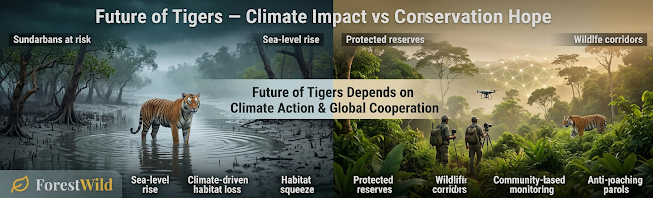
The future of the Bengal Tiger is
increasingly shaped by global environmental change, with climate dynamics
emerging as a critical factor influencing habitat stability and species
survival. While conservation efforts have successfully increased tiger
populations in India, the long-term
sustainability of these gains depends on the ability to adapt to rapidly
evolving ecological conditions.
.png "Bengal Tiger: India’s National Animal and Global Stronghold of Wild Tigers")
One of the most vulnerable landscapes is the Sundarbans, a unique mangrove ecosystem highly
sensitive to climate change. Rising sea levels, increased salinity, and the
frequency of extreme weather events threaten to submerge significant portions
of this habitat. Such changes not only reduce available territory for tigers
but also impact prey availability and freshwater resources. As a result, the
Sundarbans represent a frontline example of how climate change can directly
influence the survival of apex predators in fragile ecosystems.
Beyond regional challenges, the conservation
of tigers has become a matter of global responsibility requiring coordinated
policy action and international collaboration. Transboundary conservation
initiatives, knowledge sharing, and funding support are essential for
maintaining genetic diversity and ecological connectivity across tiger range
countries. India’s leadership in conservation, supported by frameworks such as Project Tiger, provides a model for integrating
science-based management with policy implementation at scale.
Future strategies must incorporate climate
resilience into conservation planning, including habitat restoration, corridor
expansion, and adaptive management practices. Strengthening legal protections,
investing in research, and leveraging technology will further enhance
conservation outcomes. Equally important is fostering global awareness and
cooperation, as the survival of the Bengal Tiger is intrinsically linked to
broader environmental stability.
Ultimately, the future of tigers will depend
on humanity’s ability to balance development with ecological preservation.
Protecting this iconic species is not only about saving a single animal but
about ensuring the continuity of entire ecosystems that sustain life on Earth.
CONCLUSION
The journey of the Bengal Tiger from
the brink of extinction to a symbol of conservation success stands as one of
the most compelling environmental narratives of our time. In India, where the majority of the world’s wild
tigers now reside, this recovery reflects decades of scientific effort, policy
commitment, and collective responsibility. Yet, this achievement is not an
endpoint—it is a fragile success that must be continuously protected and
strengthened.
As an apex predator and keystone species, the
survival of the Bengal Tiger is inseparable from the health of entire
ecosystems. Forests that sustain tigers also regulate climate, conserve water,
and support countless forms of life, including human communities. Protecting
tigers, therefore, is not merely about conserving a single species; it is about
preserving ecological balance and ensuring environmental resilience in an
increasingly uncertain world.
The challenges ahead—climate change, habitat
fragmentation, and human-wildlife conflict—demand sustained action, innovation,
and global cooperation. Conservation must evolve beyond protected boundaries to
embrace landscape-level strategies and community-driven solutions. The
responsibility extends beyond governments and scientists to every individual
who depends on the natural world.
Ultimately,
the future of the Bengal Tiger will serve as a measure of humanity’s commitment
to coexistence with nature. Safeguarding this iconic species means safeguarding
the forests, biodiversity, and ecological processes that sustain life on Earth.
The question is no longer whether we can save the tiger, but whether we are
willing to secure a future where both wildlife and humanity can thrive
together.
https://forestwildlifescience.lovable.app
DID YOU
KNOW?
• The Bengal Tiger represents nearly 70% of
the world’s remaining wild tiger population, making India the global center of
tiger conservation.
DID YOU
KNOW?
• Every Bengal Tiger has a unique stripe
pattern, similar to a human fingerprint, which scientists use for
identification and monitoring.
DID YOU
KNOW?
• The Sundarbans is the only mangrove
ecosystem in the world where tigers live, and these tigers are strong swimmers
adapted to saline conditions.
DID YOU
KNOW?
• Project Tiger, launched in 1973, has helped
establish more than 50 tiger reserves across India.
DID YOU
KNOW?
• A single tiger plays a crucial role in
controlling herbivore populations, helping maintain forest health and
biodiversity through ecological balance.
DID YOU
KNOW?
• Despite significant population recovery, the
Bengal Tiger remains an endangered species due to ongoing threats such as
habitat loss and climate change.
Anand Sangale.